
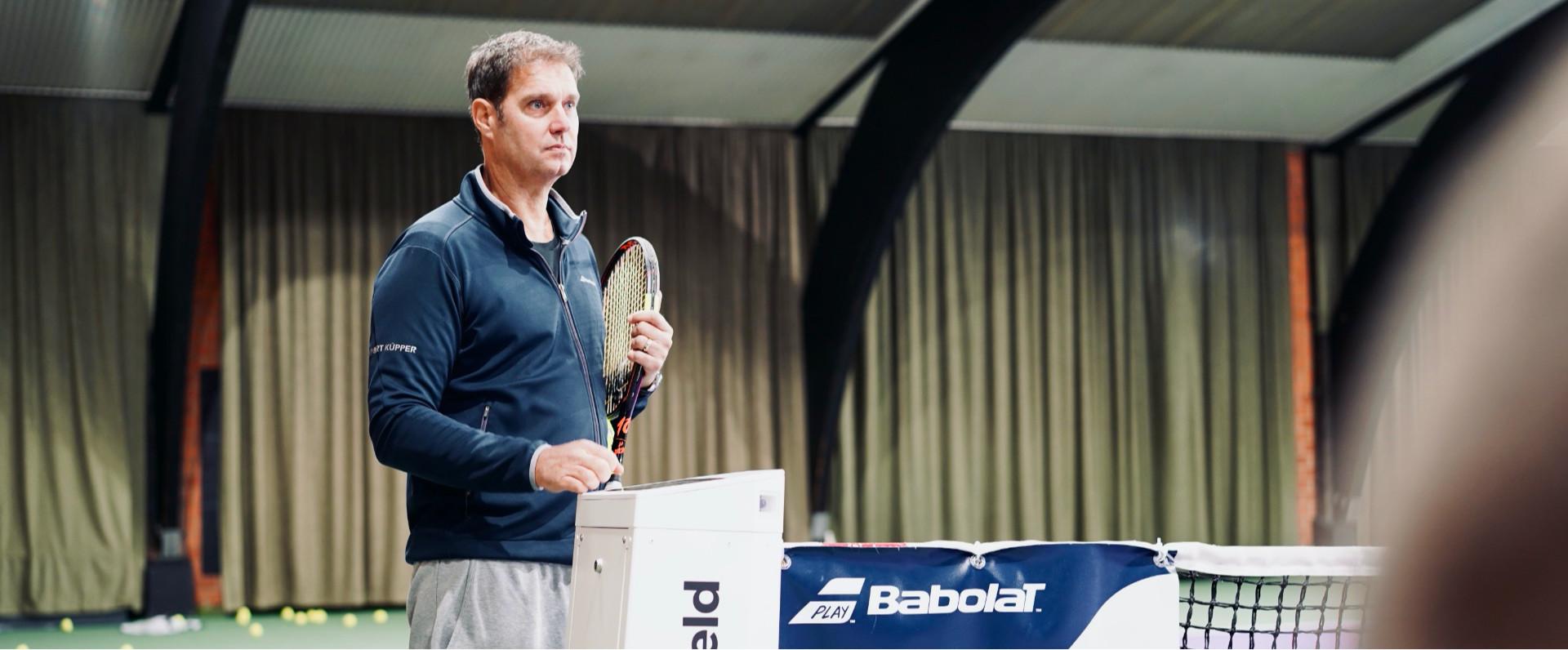
When you enter Marc-Kevin Göllner’s tennis academy in Cologne’s Rodenkirchen district, it quickly becomes clear: someone is at work here who understands tennis. This case study from Play Better shows how the former ATP Top 26 player and his coaching team use video analysis and data in training.
Key takeaways
- The academy in Cologne-Rodenkirchen has 5 indoor and 6 outdoor courts and around 30 academy players. Two courts are equipped with Wingfield.
- When needed, coaches and players go through video, speed and placement data on the tablet right after a drill. For the team, the direct visual feedback is the key to steeper learning curves.
- When players know they are being recorded, they give that decisive extra percent in practice matches. Afterwards, the coaches discuss sequences on video and derive practice focuses from the match stats.
- Regular performance tests with Wingfield drill scores make training progress measurable for the first time.
- Example Stephanie Wagner: after her serve was changed, her serve score first dropped from 65.4 to 57.7 and then rose to a record high of 70.8.
What role does technology play at the academy?
A central one: the integration of various technologies is a core part of the training concept, and on court the academy relies on Wingfield. On 5 indoor courts and 6 outdoor courts, around 30 academy players enjoy all-round support, whether on court, in the athletics area or in mental training.
- Academy
- Tennis academy of Marc-Kevin Göllner (former ATP Top 26)
- Location
- Cologne-Rodenkirchen, Germany
- Sport
- Tennis
- Courts
- 5 indoor, 6 outdoor
- Courts with Wingfield
- 2
- Used for
- Video analysis in training, practice matches, performance tests with drill scores
Marc-Kevin and his coaching team live the integration of modern training technologies. In addition to the racquet, a tablet is part of every coach’s basic equipment. Vital signs are checked during the sessions, technique is analyzed on video, development is tracked.
The former ATP Top 26 player has already equipped two courts with Wingfield. For him, direct visual feedback on the court and data-oriented practice planning and management form the basis of sustainable player development.
- at the academy
- 11courts
- 5 indoor, 6 outdoor
- academy players
- ~30
- Wingfield Courts
- 2
How does video analysis help in tennis training?
It lets players understand what the coach sees on the court, and that is one of the biggest challenges as a coach. That’s why Göllner and his coaching team go through the training data on the tablet with the athletes right after a drill when needed:
- Video for technique correction
- Speed and placement data to check whether practice goals were met
Players better understand what they are doing on the court and the impact certain adjustments have on their game. According to the team, the direct visual feedback is the key to steeper learning curves and makes the work of the entire team much easier.
How do recordings improve match practice?
As soon as players know they are being recorded, they give that decisive extra percent on the court. This is especially true in practice matches: with Wingfield, you can create match-like situations.
Afterwards, the coaches can discuss certain match sequences again on video and draw conclusions for future practice focuses based on the match statistics.
What is striking: this seems to open up completely new possibilities, especially for working with larger groups. While Göllner is working with pro Stephanie Wagner on court 1, two other players are playing a practice match on the neighboring Wingfield Court. The results are discussed together afterwards.
Wingfield is like a second pair of eyes. Knowing that I can analyze every practice again on video, I can focus on what really matters on the court.
How does the academy make training progress measurable?
With regular performance tests in which the Wingfield drill scores are measured and evaluated. Based on the data, not only can the players’ strengths and weaknesses be identified and practice content adjusted accordingly, but progress in practice can be measured for the first time.
How did Stephanie Wagner’s serve develop?
After her serve was changed, her serve score is at a record high. From the academy’s training practice:
At the end of last year, we worked on Stephanie Wagner’s strength levels and changed her serve in the process. From day one, we were able to track the impact of each week of training based on her serve scores. While an increase in her strength level was initially reflected positively in her speed scores, it had a negative impact on her serve accuracy. By making adjustments to her technique, we were able to compensate for this and ultimately solidify her serve score at a record high.
Stephanie Wagner’s serve score
Wingfield serve drill score, week 49 to week 5, with speed (SPE) and accuracy (ACC)
How is video analysis used in tennis training?
Coaches and players can go through video, speed and placement data on a tablet right after a drill. The video helps with technique correction, and the data shows whether practice goals were met. In practice matches, individual sequences can be reviewed together afterwards.
How do you measure training progress in tennis?
With regular performance tests, for example using Wingfield drill scores. They reveal strengths and weaknesses, help adjust practice content and make progress visible over weeks, for example on the serve.
Does video analysis also work for group training?
Yes. While a coach works with individual players on one court, others can play a practice match on a court with video and tracking technology. The recordings and stats are then reviewed together.
Who is video analysis in tennis training for?
For players of all levels and their coaches: beginners see their technique from the outside for the first time, while advanced players use speed and placement data to work on details. Academies and clubs also use it to make training progress measurable.